
Stop Marketing to the 5%.
Start Engineering the 95%.
Traditionally, marketing looks outward at the market.
The Neurobrand Method™ looks inward at the customer.
As the world becomes busier, the brands that lead the way are the ones that understand how humans make decisions.
SALIENCE IS A VIRTUE
Traditional branding often optimizes for recognition and attention. The Neurobrand Method goes further, designing the brand around what people notice, encode, remember and retrieve when the buying moment arrives.
Informed by real peer-reviewed principles in neuroscience, psychology, and consumer behavior to shape your strategy, the goal of the Neurobrand Method is to make your brand unforgettable and ridiculously hard to compete against.
THE PROBLEM
Your customers encounter thousands of brand messages every day. But only around 5% are in the market, ready to buy right now.
The other 95%? They’re forming memories and associations that can shape their future choices.
Traditional strategy chases the 5%.
Neurobrand Strategy is neuro-informed to build memory in the 95%.
How we Fix it.
The Neurobrand Method
THE SOLUTION: THE NEUROBRAND METHOD™
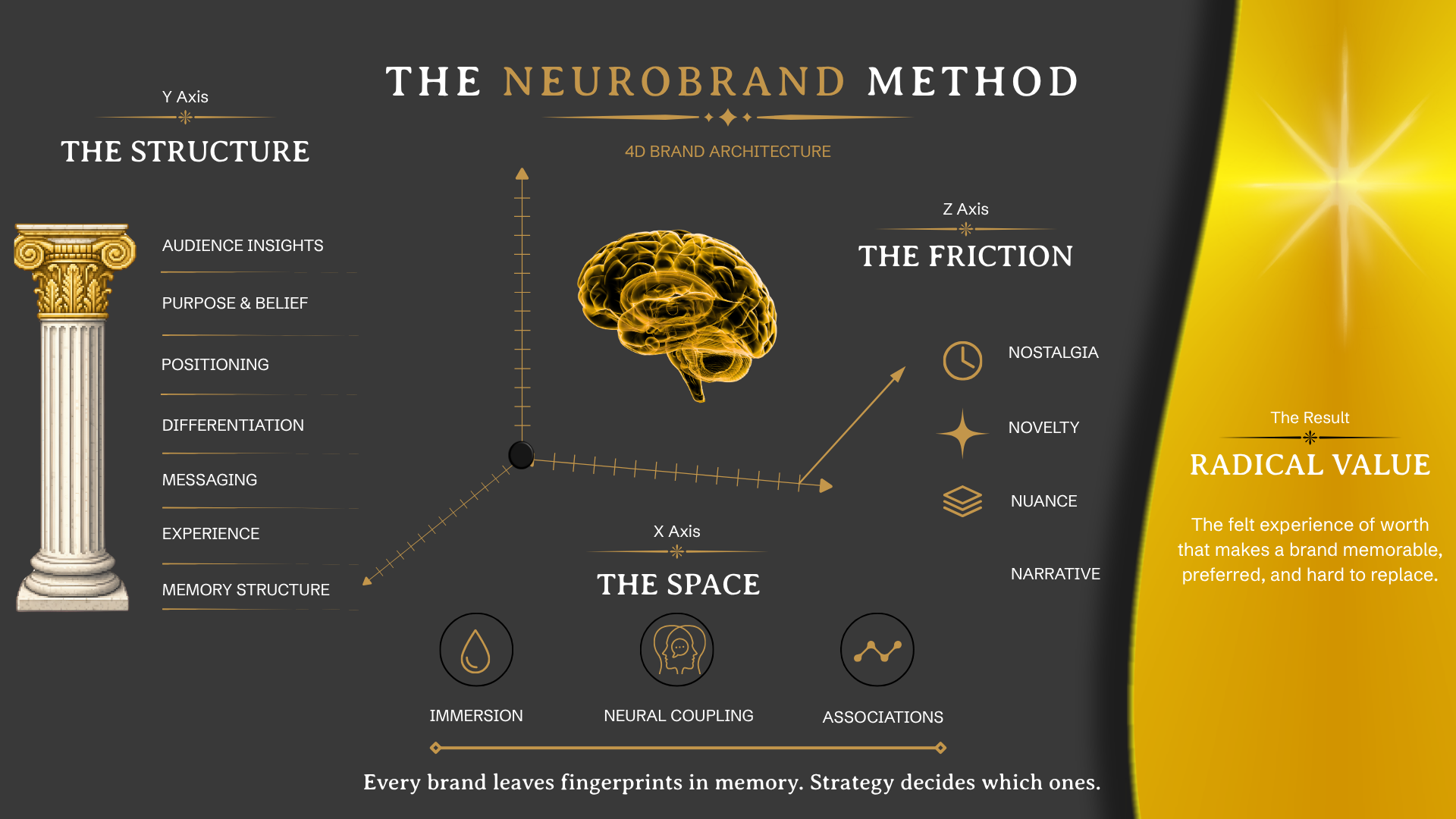
A complete system built on three neuroscience-informed principles and seven strategic elements.
Everything serves one outcome: Radical Value — the meaningful emotional value your customer feels when they engage with your brand.
3 DIMENSIONS OF THE NEUROBRAND METHOD
Dimension 1: The 3 Pillars (How the Brain Works)
Dimension 2: The 7 Elements (What You Build)
Dimension 3: The 3N's + Narrative (How Memory Sticks)
Result: Radical Value (What They Feel)
THE NEUROBRAND ADVANTAGE
Built to increase customer lifetime value over time (client results have reached 10-22% over 18 months)
Higher renewal and retention potential
Greater pricing power without relying on discounting
Clearer signals for AI-mediated discovery
Organic demand built through memory, not just reach
WHY NOW
The age of attention-based branding is ending. Memory-based competition has begun.
Brands built for memory compound recognition, preference, and demand over time.
Brands that embrace the NeuroBrand Method™ now are built to lead their category for years to come.
The ones that don’t risk being forgotten by customers, culture, and AI.
You Have a Choice
Keep paying the Invisibility Tax: fighting for clicks, discounting to win, re-explaining your value in every sale.
Or build Radical Value: a brand built for memory, the one buyers think of first when it matters.
Ready to Engineer Your Brand’s Memory?
The Neurobrand Method™ isn’t just about understanding the brain — it’s about applying neuroscience-informed principles to build a Category of One.
Apply to work with Rande Vick and implement the Method in your business.
The Neurobrand Method™ synthesizes research and ideas from leading voices in neuroscience, marketing, and strategy, drawing on work associated with Paul Zak (Neurobiology), Uri Hasson (Communication and Neural Coupling), Matt Johnson (Consumer Neuroscience), Charan Ranganath (Memory Science), Daniel Kahneman (Behavioral Economics), Lisa Feldman Barrett (Emotion), Alex Smith (Strategy), Lisa Genova (Memory), Craig Stark, and Iain McGilchrist (Philosophy).
The Neurobrand Method Explained
Three dimensions of a neuro-informed brand strategy
THE 3 PILLARS: The Science Behind the Strategy
Immersion: Why Some Moments Stick
When people become deeply engaged in an experience, attention and emotional involvement increase, and emotionally significant experiences can be more memorable. Research by Paul Zak and others has explored the relationship between narrative engagement, emotional response, and memory.
Most brands stir emotion but never create a moment that matters. We design meaningful peak moments that give people something worth remembering, and a reason to connect that memory to your brand.
Neural Coupling: How Stories Create Shared Meaning
When you're absorbed in a story, your brain activity can become aligned with the storyteller's. Uri Hasson's research found that neural coupling during storytelling is associated with how successfully information is communicated and understood.
Most brand stories fall flat because they're either too generic or too self-centered. We build narratives around the customer's own future — close enough to feel familiar, and far enough to feel aspirational — so people can see themselves in the story.
Subconscious Associations: How Familiarity Can Shape Preference
The brain learns through association. Repeated exposure to consistent cues like colors, sounds, language, symbols and experiences can strengthen the associations people have with a brand and make it easier to recognize and retrieve.
Most brands constantly change how they show up, weakening the distinctive cues that help people recognize them. We build consistent patterns that become familiar, distinctive and easier to recall when the buying moment arrives.
*Familiarity doesn't guarantee preference. But when familiarity is paired with positive associations and distinctive cues, it can make a brand easier to recognize, remember and consider.
THE 7 ELEMENTS: WHAT YOU BUILD
1. Audience Insight: Who Your Buyer Is Becoming
We map identity, hopes, and motivations, not just demographics. People buy who they become through your brand. The goal is to surface the unspoken motivations driving your market.
2. Purpose & Belief: Belonging and Shared Identity
Belonging, status, and tribe are among the strongest drivers of loyalty. We define the belief system your brand stands for and invites people into.
3. Brand Positioning: Where the Brain Files You
The brain has to file you before it can remember you. We define your Onliness Position (a nod to Marty Neumeier): the distinctive idea only you own.
4. Differentiation: Contrast That Gets Noticed
The brain notices difference and discards sameness. We design deliberate contrast that makes you recognizable at a glance.
5. Messaging: Language People Can Remember and Repeat
Positioning only works when it becomes words people can store and pass on. We build structured messaging that holds its shape no matter who is telling it.
6. Brand Experience: Peak and End Moments
Daniel Kahneman's research on the peak-end rule showed that, when people remember an experience, the most intense moment and the ending can disproportionately influence their overall evaluation of it.
A brand is what people remember feeling. We identify and design emotionally significant moments across the customer journey, especially the moments people are most likely to carry forward.
7. Memory Structure: Repetition, Cues, and Recall
Memory isn't a recording. It's formed, strengthened, and retrieved through associations, context, emotion, goals, and cues. Drawing on memory research from scientists including Charan Ranganath and Craig Stark, we build systems that help your brand form stronger associations, reinforce them over time, and come to mind when the buying moment arrives.
THE 3 N'S + NARRATIVE: HOW MEMORY STICKS
Nuance: A sharp, ownable point of view that sets your brand apart.
Novelty: A break in the pattern that the brain flags as worth attention.
Nostalgia: Emotional familiarity that builds trust and belonging.
Narrative: The story that binds all three into a coherent memory.
RADICAL VALUE: THE RESULT
The feeling your customer carries after engaging with your brand, long after the product and the price are forgotten.
What does your customer become by choosing you?
In a commoditized market, Radical Value is what separates brands that are chosen from brands that are forgotten.
CREATED BY
Rande Vick, Executive Brand Strategist
Founder, VICK Brand Strategy
Author, NeuroBranding: The Brain-Based Method to Make Your Brand Unforgettable
Author, Radical Value: Building Brands That Are Uncannily Memorable
The NeuroBrand Method™ grew from years of field work with brands, informed by research in neuroscience, psychology, and consumer behavior.